
Arborist Pre-Lift Weight Log Automation: Killing the $10,000 Crane Overload Lockout Tax

Automation Edge Intel
Trade Automation Experts
Eye-balling the weight of a massive timber section is a gamble. In high-hazard tree removal, that gamble destroys margins. When you deploy a 100-ton crane for backyard removals, guessing is the fast track to a catastrophic failure or a massive financial penalty.

Automate Your Operations with Make.
Connect your apps, design custom visual workflows, and save 10+ hours a week.
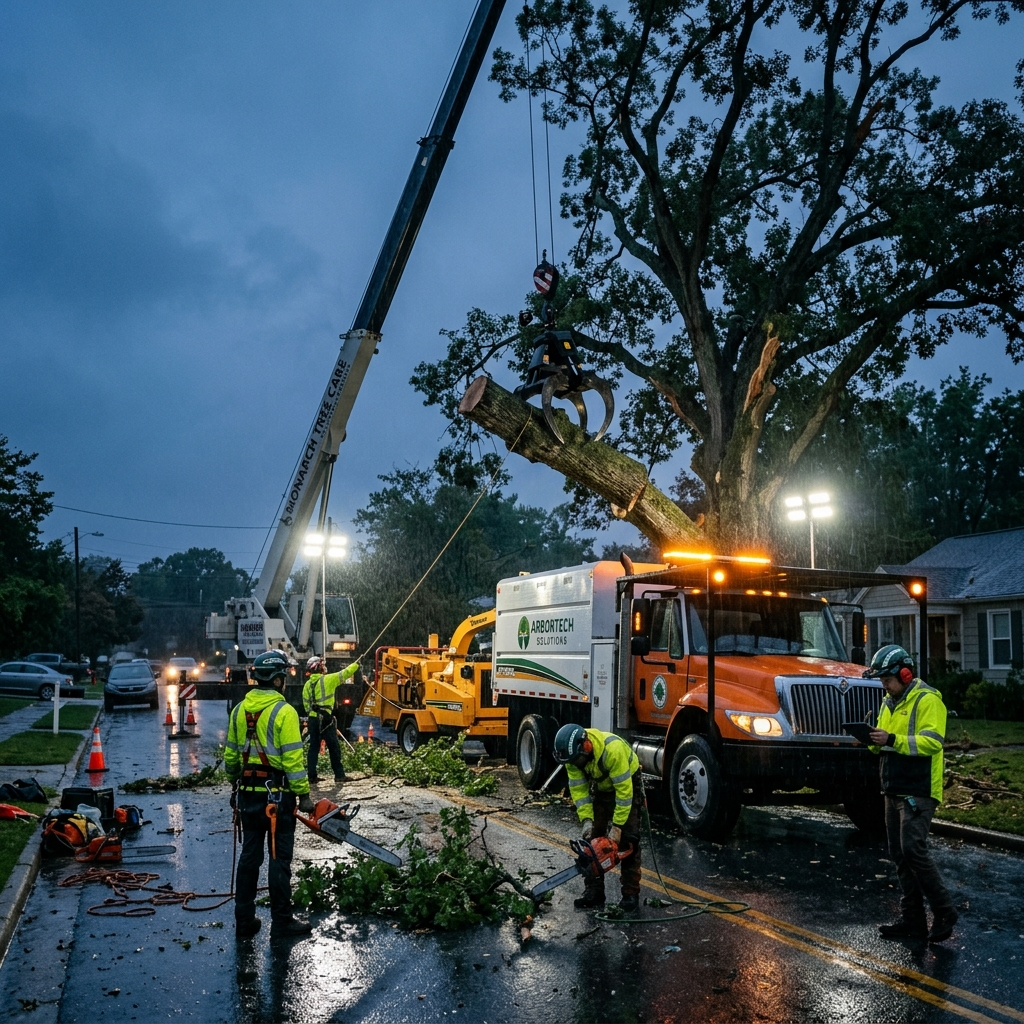
Climbers working 80 feet in the canopy make rapid cuts. If a cut section exceeds the crane’s safe working load for its active boom radius, the crane’s computer (the Load Moment Indicator, or LMI) trips. The crane locks down instantly. The loaded boom is frozen, the climber is stranded in the danger zone, and operations halt. Resetting an LMI safety lockout often requires a certified field technician, turning a routine removal into a multi-hour standby nightmare. You end up eating a $10,000 crane standby tax while your crew sits idle.
To scale to an eight-figure empire, you must remove human error from field calculations. This is how you transition from owner-operator to elite system builder.
The Silent Margin Killer: Green Log Weight Guesswork
Every tree species has a distinct green weight density. A cubic foot of green white oak weighs 63 pounds, while a cubic foot of white pine weighs just 36 pounds. When climbers guess without accurate calculation, they either cut pieces that are too small—bloating your labor hours—or too large, locking up the crane.
Relying on paper weight charts in the field does not work. Wet, grease-stained reference sheets stay buried in the glovebox. Just as heavy transport operators use automated logs to avoid a cribbing damage backcharge, high-hazard arborist fleets require immediate, automated safety clearance before the chainsaw bites wood.
The Field-Tested Fix: Real-Time Lift Calculations
We solved this operational bottleneck using Make.com to bridge the gap between the canopy and the crane cab. By automating the math, we remove human guesswork entirely.
When your ground crew or climber inputs basic dimensions into their mobile field management software, GoHighLevel, the calculation occurs in milliseconds behind the scenes. The system returns an instant Go/No-Go text to the crew. If the lift is safe, they cut. If it is over-limit, they split the section.
Here is what each node in the scenario builder does:
GoHighLevel Webhook: Captures structural dimensions and species data submitted via mobile fields during rigging setup.
Density Lookup: Performs an instant search in Airtable for the specific timber species' wet density multiplier.
Weight Engine: Computes standard volumetric equations automatically to output the section weight.
Safety Filter: Assesses weight limits against mapped safe limits for active boom radii on site.
Twilio SMS: Broadcasts clear Go/No-Go text commands to field operators in seconds.
Implementation Path
Two Ways to Deploy This
You do not need to understand webhooks or API modules to fix this leak. Pick the path that matches how you operate.
Path 1 — Build It Yourself
Sign up for Make, follow the blueprint above, and connect your field software. No code required — just drag, drop, and connect the modules shown in the diagram.
Start with Make.com →Path 2 — Hire a Pro (Recommended for Non-Technical Operators)
Don't want to touch the tech? Hire a vetted Make.com automation specialist to build this exact workflow for you. Hand them this article as the build spec — they will know exactly what to wire up.
Hire a Make.com Expert on Fiverr →Running a larger operation with multi-system integrations? Browse Make.com specialists on Upwork for bigger builds.
Implement the Protocol
Stop letting gut-check decisions dictate your project safety and profit margins. Automating this calculation keeps your climbers safe, your crane assets moving, and your heavy equipment backcharges at zero. To build a highly optimized, self-running fleet, choose the right tools by checking out our Software Guide.
Verified Automation Stack




Built for 8-Figure Scale
Used by elite operators with GoHighLevel, Make, and ServiceTitan to automate dispatch, voice triage, and invoice routing.
Intelligence Audit: The GoHighLevel + ServiceTitan Edge
For contractors looking to move from a lifestyle business to a scalable empire, GoHighLevel handles CRM, SMS, and booking pipelines while ServiceTitan powers enterprise dispatch at scale. Together they optimize your profit margins.
- Smart Dispatch: Uses historical technician conversion rates to put your best sellers on the highest-value leads.
- Marketing Pro: Automatically tracks every dollar of ad spend to a closed invoice, giving you real-time ROI.
- Pricebook Pro: Standardizes your pricing across the fleet to ensure you never underquote a job again.
ANALYTICS SNAPSHOT:
- Average Revenue Growth: +25%
- Office Admin Efficiency: +40%
- First-Time Fix Rate: +12%
Arborist Fleet Fuel Savings ROI
At the current US average of $3.99/gal, a 10-truck arborist fleet (crew/chipper trucks) spends approximately $64,789/year on fuel. AI-driven route density reduces that by 15%, saving your operation $9,718+ per year—every year, automatically.
Related Intelligence
Read NextEmergency Pack-Out Inventory Automation: Killing the $9,500 Missing Item Claim Leak
Lateral Launch CCTV Video Log Automation: Killing the $12,500 Retainage Release Lockout
Police Rotation SLA Log Automation: Killing the $14,000 Suspension Leak
Stay ahead of the curve.
Join 15,000+ independent contractors getting the daily edge on automation.