
Heavy Wrecker Dispatch Growth & Automation: Locking Down $10k Class 8 Police Rotation Jobs

Automation Edge Intel
Trade Automation Experts
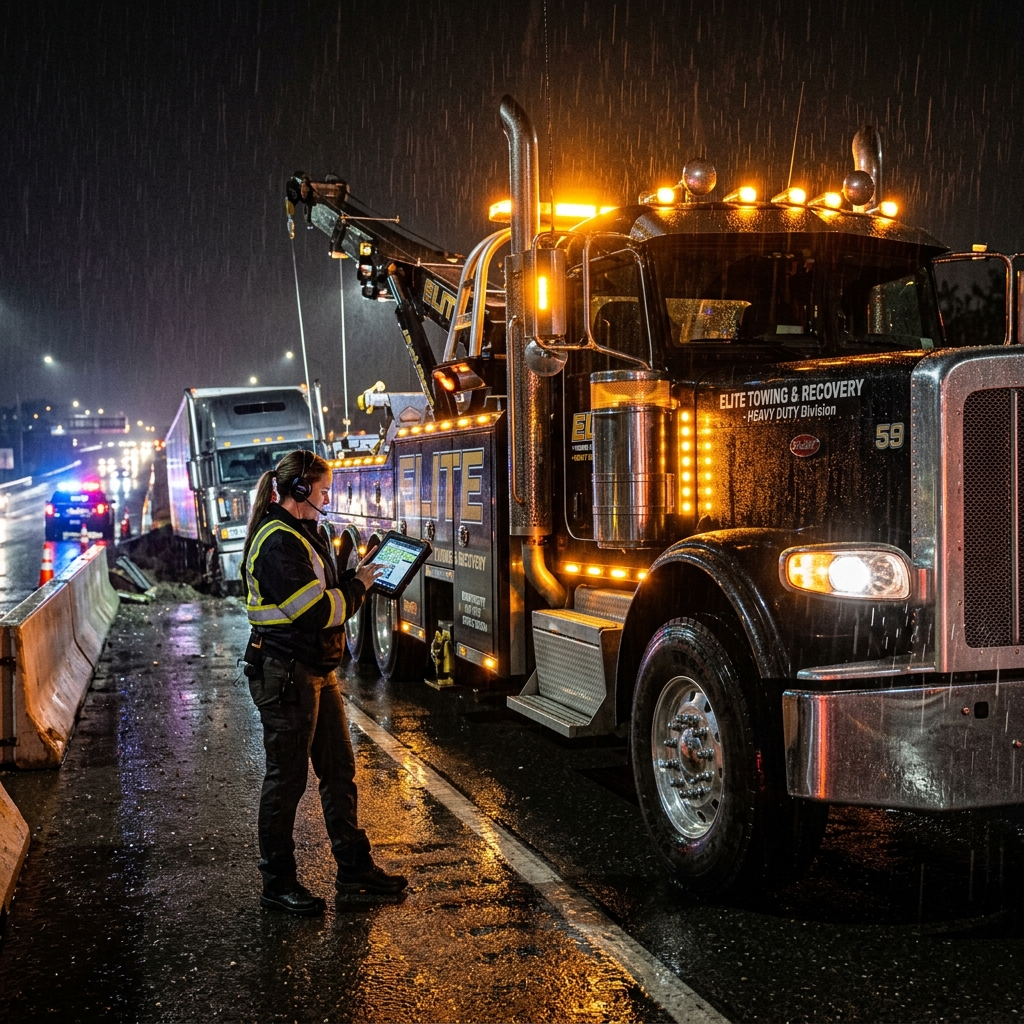
In the heavy towing world, minutes cost thousands. When a Class 8 tractor-trailer jackknifes across three lanes of the interstate, the municipal police rotation clock starts ticking. You have exactly three minutes to accept the call, verify you have a 50-ton rotator available, match it with a CDL-A operator, and provide an ETA.

Automate Your Operations with Make.
Connect your apps, design custom visual workflows, and save 10+ hours a week.
If your dispatch desk takes four minutes? The officer clicks the next name on the list. You just lost a $10,000 heavy recovery, rigging, and storage ticket. That is the cost of manual operations.
Most heavy wrecker owners are stuck in the truck trap. You are either driving the rotator yourself, or your phone is glued to your chest 24/7. You are managing fleet availability on a grease-stained dry-erase board. If you want to scale to an 8-figure enterprise, you must automate the dispatch loop.
This protocol details how to build a zero-lag heavy wrecker dispatch automation pipeline using Make.com and GoHighLevel to capture municipal leads before the rotation desk skips your name.
The Profit Leak: The 180-Second Rotation Penalty
The primary point of failure is human verification. When a police dispatcher calls, your desk operator must check three separate pieces of data: which rotators are clear, which heavy-duty operators are awake, and how fast they can roll. By the time they log into their GPS tracking, text three drivers, and look at the whiteboard, the police dispatch operator has already hung up.
This is a systemic leak. Just like we addressed in our guide on the 30-Minute Dispatch Lag, speed of response is the only metric that matters to municipal partners. If you cannot automate the verification of heavy assets, you do not own a scalable business; you own a high-stress job.
By moving fleet status tracking and driver availability into a cloud-based system like GoHighLevel, you can select the right tools for your business. For a deep comparison of field software, check our Software Guide.
The Field-Tested Fix: Zero-Lag Heavy Recovery Pipeline
To kill this leak, we use Make.com to act as the central operational brain. It instantly processes incoming dispatch data, matches it with truck locations, checks driver certifications, and sends immediate alerts to your ready-to-roll operators.
Step-by-Step Visual Blueprint Demo
Here is exactly how to build this automated routing engine yourself without writing a single line of code:
- Step 1: The Smart Proximity Webhook (Trigger)
Set up a Custom Webhook in Make.com. This listener captures the raw email or API data from your municipal dispatch platform (or CAD system) the second a heavy-duty wreck alert is logged. - Step 2: The GoHighLevel Asset Verification Node (Action)
Connect this node to your GoHighLevel account. Set it to query your custom "Heavy Fleet" properties. It checks which 50-ton or 75-ton rotators are flagged as "In-Service" and "Available" within a 20-mile radius of the incident coordinates. - Step 3: The Driver Matching Router (Filter Gate)
Set up a router module to filter out operators who do not possess a CDL-A or specialized heavy-recovery certification. It matches current on-duty driver shifts with geographic proximity to the rollover location. - Step 4: The High-Velocity SMS Dispatch Trigger (Action)
Connect a Twilio or SMS module. This instantly sends a priority text blast to the designated on-duty driver with the precise location, asset ID, and recovery instructions. It simultaneously prepares a auto-response text for the dispatcher to send to the police desk, confirming acceptance with an accurate ETA in under 45 seconds.
The Operator Verdict
Continuing to run Class 8 operations manually is a massive financial drain. Every skipped police rotation is a five-figure hit to your top-line revenue. By letting cloud systems check truck statuses, match drivers, and send notifications in seconds, you protect your fleet's position on municipal lists.
Stop living in the truck. Build your automation engine today, take control of your dispatch loop, and start operating like an 8-figure business.
Implementation Path
Two Ways to Deploy This
You do not need to understand webhooks or API modules to fix this leak. Pick the path that matches how you operate.
Path 1 — Build It Yourself
Sign up for Make, follow the blueprint above, and connect your field software. No code required — just drag, drop, and connect the modules shown in the diagram.
Start with Make.com →Path 2 — Hire a Pro (Recommended for Non-Technical Operators)
Don't want to touch the tech? Hire a vetted Make.com automation specialist to build this exact workflow for you. Hand them this article as the build spec — they will know exactly what to wire up.
Hire a Make.com Expert on Fiverr →Running a larger operation with multi-system integrations? Browse Make.com specialists on Upwork for bigger builds.
Verified Automation Stack




Built for 8-Figure Scale
Used by elite operators with GoHighLevel, Make, and ServiceTitan to automate dispatch, voice triage, and invoice routing.
Intelligence Audit: The GoHighLevel + ServiceTitan Edge
For contractors looking to move from a lifestyle business to a scalable empire, GoHighLevel handles CRM, SMS, and booking pipelines while ServiceTitan powers enterprise dispatch at scale. Together they optimize your profit margins.
- Smart Dispatch: Uses historical technician conversion rates to put your best sellers on the highest-value leads.
- Marketing Pro: Automatically tracks every dollar of ad spend to a closed invoice, giving you real-time ROI.
- Pricebook Pro: Standardizes your pricing across the fleet to ensure you never underquote a job again.
ANALYTICS SNAPSHOT:
- Call-to-Job Conversion: +18%
- Fuel Cost Reduction: -15%
- Dispatch Efficiency: +28%
Towing Fleet Fuel Savings ROI
At the current US average of $3.99/gal, a 10-truck towing fleet (wreckers) spends approximately $170,871/year on fuel. AI-driven route density reduces that by 15%, saving your operation $25,631+ per year—every year, automatically.
Related Intelligence
Read NextEmergency Pack-Out Inventory Automation: Killing the $9,500 Missing Item Claim Leak
Lateral Launch CCTV Video Log Automation: Killing the $12,500 Retainage Release Lockout
Police Rotation SLA Log Automation: Killing the $14,000 Suspension Leak
Stay ahead of the curve.
Join 15,000+ independent contractors getting the daily edge on automation.