
High-Hazard Utility Clearance Growth & Automation: Killing the $3,000 Crane Idle Tax

Automation Edge Intel
Trade Automation Experts
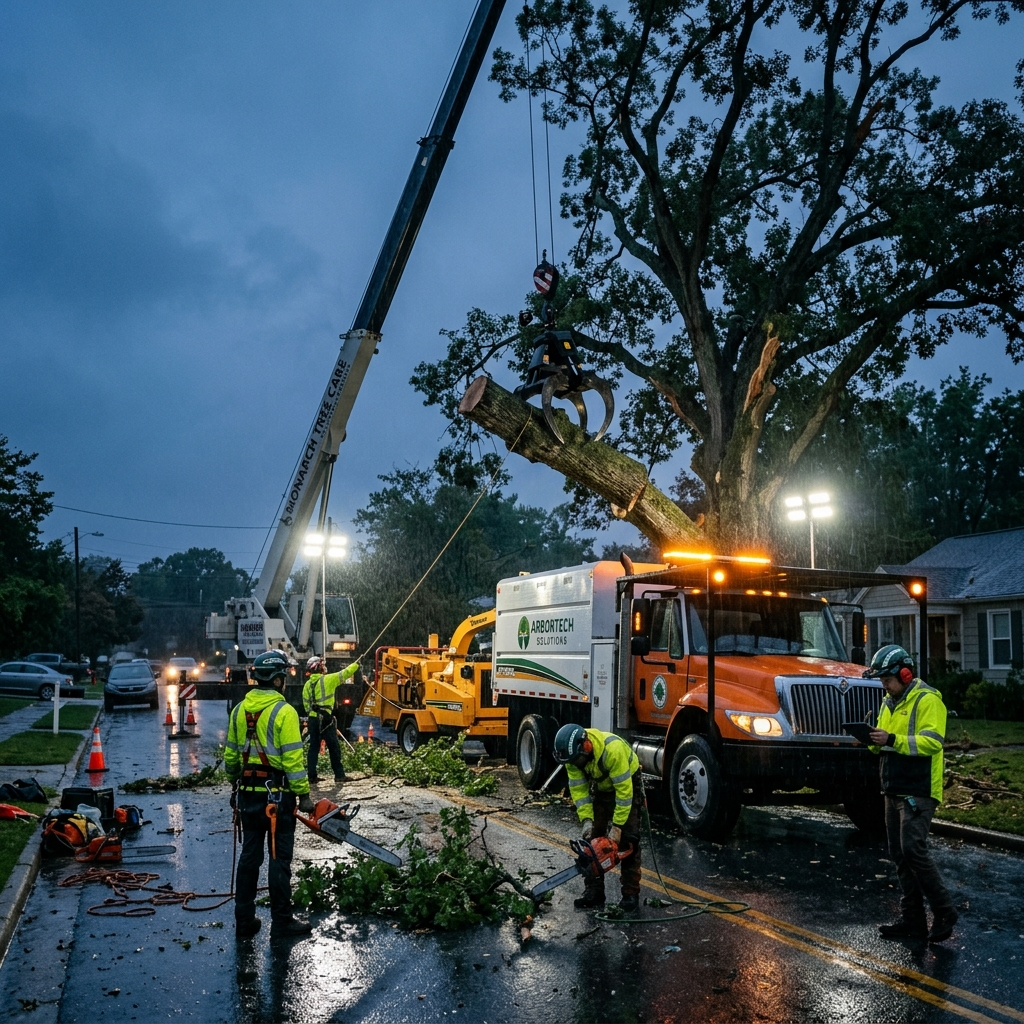
An emergency call drops at 2:00 AM. A 90-foot white oak has split, leaning heavily against a high-voltage primary feeder line over a commercial building. This is a $15,000 emergency extraction. You roll your 50-ton crane, a bucket truck, and a five-man crew. The meter is running at $650 per hour in active labor and machinery overhead.

Automate Your Operations with Make.
Connect your apps, design custom visual workflows, and save 10+ hours a week.
Your team arrives on-site, but they cannot touch the tree. The local utility provider must drop the service lines or sleeve the primary conductors first. Your crew stands in the street, arms crossed, staring at the sky. Your crane operator idles the rig, burning diesel and profit margin.
You are caught in the Utility Coordination Void. While your crew sits, you are trapped on hold with utility dispatch, trying to reach a supervisor who can authorize a line technician. By the time the utility truck arrives three hours later, you have burned nearly $2,000 in unbillable idle time. Your net margin on the emergency job has been cut in half.
The Core Profit Leak: The Utility Clearance Gap
For high-hazard arborist operations, profitability hinges on machine utilization. Every minute a crane or a $250,000 spider lift sits idle because of third-party utility delays is a direct drain on your cash flow. Relying on manual phone calls, emails, and frantic texts to coordinate emergency utility drops is a broken operational model.
To build an 8-figure tree removal empire, you must remove yourself from this communication loop. High-performance operators automate utility coordination the moment an emergency contract is booked. By deploying an automated dispatch pipeline, you can alert local utility desks, coordinate crane arrival windows, and update field teams without making a single phone call.
Using a centralized CRM like GoHighLevel paired with smart automation, you can run this entire play on autopilot. To understand how this fits into your overall technology ecosystem, consult our Software Guide.
The Field-Tested Fix: Automated Utility Dispatch Pipelines
The solution is an automated, zero-touch clearance router. When an estimator or dispatcher flags a job as an emergency utility hazard in your field service software, an automated system instantly extracts the exact geographic coordinates, generates a priority utility ticket, alerts the utility service desk, and schedules the crane operator with a precise staging delay.
We build this exact workflow using Make.com. It connects your field dispatch systems directly to communication APIs and utility notification desks, bypassing the manual administrative bottleneck entirely.
Here is the exact visual architecture of the automated system:
GoHighLevel Trigger: This module monitors GoHighLevel for newly approved emergency work orders. It instantly extracts job notes, site addresses, customer details, and custom field tags.
Hazard Filter: This filtering gate checks if the work order contains specific tags such as 'Utility Clearance Required' or 'Power Line Hazard'. If the criteria are not met, the scenario halts to avoid duplicate alerts.
Utility Router: Once validated, this module compiles the GPS coordinates and photos of the hazard. It automatically generates and sends an emergency dispatch email or API ticket directly to the local utility provider's priority line clearance inbox.
Crew Dispatch: Simultaneously, this action node sends SMS alerts to your crane operator and crew lead, providing them with the exact site location, utility contact ticket number, and a calculated staging delay to ensure they do not arrive until the power company has scheduled their technician.
Step-by-Step Blueprint: Setting Up the Pipeline
Building this automated clearance pipeline does not require writing complex code. Follow these direct steps to lock down your field operations:
Step 1: Configure Custom Tags in GoHighLevel
Open your field service management portal. Under job custom fields, create a dropdown menu labeled 'Utility Action Required'. Populate it with options: 'Sleeve Lines', 'Drop Service Line', and 'No Utility Action'. This simple classification ensures your field estimators can trigger the automation right from their mobile phones while standing under the canopy.
Step 2: Build the Trigger Webhook
Log into your automation platform. Select GoHighLevel as the trigger module. Choose the 'New Job' event. Link your account and run a test capture. This pulls the raw payload data containing your custom field values, customer address, and job notes.
Step 3: Define the Filtering Gate
Insert a router or filter directly after the trigger. Set the condition to check your custom field. The automation should only proceed if 'Utility Action Required' is equal to 'Sleeve Lines' or 'Drop Service Line'. This prevents false alarms on standard tree trimming jobs.
Step 4: Format and Route the Emergency Ticket
Configure an email or API request node. Use a template that formats the alert into a professional, high-priority request. Dynamically insert the customer's street address, exact GPS coordinates, and the custom tag. Send this to the regional utility's designated contractor desk. By formatting this data cleanly, you bypass their basic customer support tier and route directly to operations.
Step 5: Stagger the Crane Dispatch
Do not send your crane operator to the job site immediately. Use a delay node or a calculated scheduled message. Send an automated SMS to your crane operator with the details: 'Emergency utility drop requested for [Address]. Do not mobilize until [Staging Time]'. This single operational delay prevents heavy equipment from sitting cold in the street while the power company mobilizes.
The Bottom Line: Protection of Your Margins
Operating a high-hazard tree removal fleet without automation is a massive liability. Every hour your heavy machinery sits idle is profit permanently lost. By automating utility coordination, you protect your crew's billable hours, dramatically reduce administrative load, and position your brand as the fastest responder in your market.
Stop playing dispatcher on three-way phone calls at 2:00 AM. Build this automation, exit the truck trap, and run your tree care fleet with mathematical precision.
Implementation Path
Two Ways to Deploy This
You do not need to understand webhooks or API modules to fix this leak. Pick the path that matches how you operate.
Path 1 — Build It Yourself
Sign up for Make, follow the blueprint above, and connect your field software. No code required — just drag, drop, and connect the modules shown in the diagram.
Start with Make.com →Path 2 — Hire a Pro (Recommended for Non-Technical Operators)
Don't want to touch the tech? Hire a vetted Make.com automation specialist to build this exact workflow for you. Hand them this article as the build spec — they will know exactly what to wire up.
Hire a Make.com Expert on Fiverr →Running a larger operation with multi-system integrations? Browse Make.com specialists on Upwork for bigger builds.
Verified Automation Stack




Built for 8-Figure Scale
Used by elite operators with GoHighLevel, Make, and ServiceTitan to automate dispatch, voice triage, and invoice routing.
Intelligence Audit: The GoHighLevel + ServiceTitan Edge
For contractors looking to move from a lifestyle business to a scalable empire, GoHighLevel handles CRM, SMS, and booking pipelines while ServiceTitan powers enterprise dispatch at scale. Together they optimize your profit margins.
- Smart Dispatch: Uses historical technician conversion rates to put your best sellers on the highest-value leads.
- Marketing Pro: Automatically tracks every dollar of ad spend to a closed invoice, giving you real-time ROI.
- Pricebook Pro: Standardizes your pricing across the fleet to ensure you never underquote a job again.
ANALYTICS SNAPSHOT:
- Average Revenue Growth: +25%
- Office Admin Efficiency: +40%
- First-Time Fix Rate: +12%
Contractor Fleet Fuel Savings ROI
At the current US average of $3.99/gal, a 10-truck contractor fleet (work trucks) spends approximately $49,838/year on fuel. AI-driven route density reduces that by 15%, saving your operation $7,476+ per year—every year, automatically.
Related Intelligence
Read NextEmergency Pack-Out Inventory Automation: Killing the $9,500 Missing Item Claim Leak
Lateral Launch CCTV Video Log Automation: Killing the $12,500 Retainage Release Lockout
Police Rotation SLA Log Automation: Killing the $14,000 Suspension Leak
Stay ahead of the curve.
Join 15,000+ independent contractors getting the daily edge on automation.